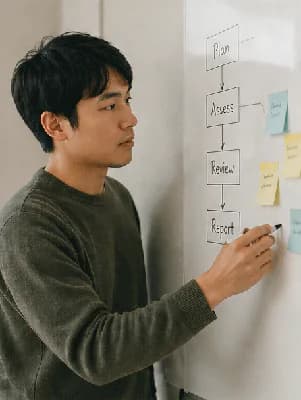
Observation-based assessments are widely used in schools, especially in early childhood and developmental contexts.
They allow teachers to document what students do, how they interact, and how they progress over time. When done well, they provide a rich and grounded view of learning.
But in many schools, observations are recorded in inconsistent ways.
Some are written as loose notes. Others follow informal formats. Over time, this makes it difficult to revisit, compare, or use them in reports.
The value of observation is not only in noticing.
It is in how those observations are structured.
The challenge with unstructured observations
Teachers observe constantly during the school day.
The challenge is not collecting information. It is organizing it.
Without a clear structure:
- observations vary in format from one teacher to another
- important details may be missed or recorded unevenly
- it becomes difficult to compare development over time
- turning observations into reports requires additional effort
This often leads to a disconnect.
Teachers take notes during the term, but when it is time to write reports, they need to reinterpret or rewrite those notes into a different format.
The process becomes longer and less precise.
What a structured observation looks like
A structured observation does not limit what teachers notice.
It organizes how that information is recorded.
A clear structure usually includes:
Defined categories or domains
For example: social interaction, communication, motor skills, or subject-specific areas.
Focused prompts or questions
Instead of open-ended notes, teachers respond to specific prompts that guide attention.
Consistent response formats
This can include selected options, short written feedback, or a combination of both.
Optional qualitative notes
Space remains for teachers to add context and describe what they observed in their own words.
With this approach, observations become easier to read, compare, and use later.
Building a structure that supports teachers
Creating structure does not mean adding complexity.
The goal is to support teachers in capturing what they already observe, in a way that remains usable over time.
Practical steps include:
1. Define what should be observed
Agree on the key areas that matter for your school or age group.
2. Break observations into sections
Group related prompts so teachers can move through them naturally.
3. Use simple and consistent response types
Avoid mixing too many formats. Keep it clear and repeatable.
4. Keep space for narrative context
Structured inputs are useful, but they should not replace descriptive insight.
5. Reuse the same structure across terms
This allows observations to build on each other instead of starting over.
When these elements are in place, observations become part of a continuous process rather than isolated notes.
Connecting observations to reports
One of the most common challenges is the gap between observing and reporting.
When observations are unstructured, teachers often need to rewrite them into narrative form for reports.
A structured approach reduces this gap.
- observations are already organized by category or domain
- language used during observation can inform report writing
- patterns and progress are easier to identify
- reports reflect what was actually observed, not what is remembered later
This creates a more direct path from daily practice to formal communication with families.
Where tools can support the structure
Maintaining structured observations across classes and teachers can be difficult without support.
A dedicated system can help by:
- providing shared templates for observation-based assessments
- allowing teachers to record responses within defined sections
- keeping observations organized by student and period
- making it easier to use observation data when writing reports
This kind of structure supports consistency without removing flexibility.
Platforms like Avalium are designed to organize observation-based assessments within a clear workflow, helping schools connect daily observations with report writing.
Reflection
Observation is one of the most valuable tools teachers have.
But its impact depends on how it is documented.
When observations are structured, they become easier to use, easier to share, and more meaningful over time.
Instead of collecting scattered notes, schools begin to build a consistent record of student development.
And that consistency supports both teaching practice and communication with families.