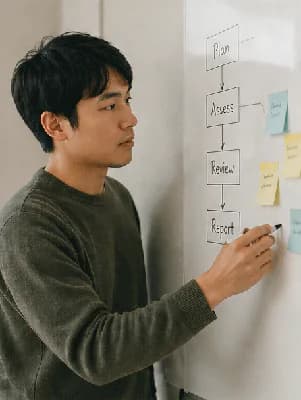
In many schools, report writing is one of the most demanding periods of the academic year. It requires attention, care, and a clear understanding of each student. It is also work that often extends beyond the classroom, taking time from planning, rest, and other responsibilities.
The challenge is not only the amount of writing. It is how that writing is organized, repeated, and reviewed over time.
When the process lacks structure, even experienced teachers can find themselves spending more time than necessary on reports.
Why report writing takes so much time
Rewriting similar feedback each term
Teachers often return to the same ideas when describing a student's development. Without a way to build on previous observations, these reflections are written again from the beginning.
This repetition is not always visible, but it adds up across classes and reporting periods.
Working across multiple formats and documents
In many schools, assessments are not kept in one place. Notes may be written in different documents, shared folders, or personal files.
When it is time to write reports, teachers need to gather this information again. This process takes time and increases the risk of inconsistency.
Differences in how reports are written
Each teacher brings their own voice and approach to writing. This is valuable, but without a shared structure, reports can vary in format, level of detail, and organization.
Coordinators often spend time reviewing and adjusting reports so they follow a consistent standard.
Time spent organizing and formatting
Before a report is ready to be shared, it often needs to be organized, reviewed, and formatted.
- structuring sections
- checking language
- preparing the final document
What changes when the process is structured
Reducing time does not mean writing less carefully. It means supporting teachers with a process that allows their work to build over time.
Building on previous observations
When observations are stored in a structured way, teachers can revisit and expand them instead of starting again.
This allows reports to reflect continuity in the student's development.
Keeping assessments in one place
A clear structure brings together:
- observations
- subject feedback
- assessment records
Using shared structures across the team
When teachers work with the same structure:
- reports become easier to read
- expectations are clearer
- review time is reduced
Reducing manual preparation
When reports follow a consistent format from the beginning, there is less need for adjustments at the end.
Preparation becomes part of the process, not an extra step.
Supporting teachers without reducing quality
Time savings should not come from simplifying what teachers write. It should come from supporting how that writing is developed and organized.
A well-structured process allows teachers to:
- focus on the student
- write with clarity
- avoid unnecessary repetition
Where tools can support this process
Some schools choose to support their assessment process with tools designed for this purpose.
These tools can help by:
- organizing assessments in a consistent structure
- allowing teachers to build on previous work
- preparing reports for sharing without additional formatting
How Avalium supports this workflow
In Avalium, assessments are created within a clear structure and can be developed over time. Reports are then generated directly from this work, ready to be downloaded, printed, or shared with families.
The intention is not to replace the teacher's writing, but to support it with a process that reduces repetition and manual work.
Closing reflection
Report writing will always require time and attention. It is an important part of understanding and communicating student development.
However, when the process is well organized, that time can be used more effectively.
Instead of repeating work, teachers can focus on what matters most: observing, understanding, and supporting each student.