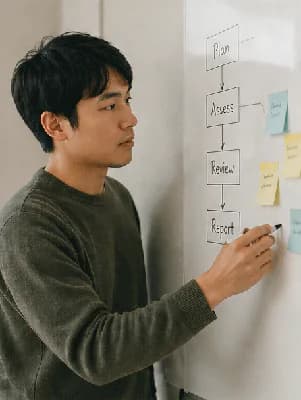
In many schools, report writing follows a familiar pattern.
At the end of each term, teachers return to their notes, try to recall previous observations, and begin writing again. Even when the student's development is continuous, the documentation often starts from zero.
The result is not just time spent. It is fragmentation.
What should be a cumulative understanding of the student becomes a series of disconnected texts.
The problem behind the repetition
At first glance, rewriting feedback may seem like part of the process. Students change, and reports need to reflect that.
But the repetition is rarely intentional. It usually comes from how the workflow is structured.
Common patterns include:
- previous reports stored as static PDFs or documents
- observations written in separate notes or tools
- no clear connection between one term and the next
- lack of shared structure across teachers
Because of this, teachers cannot build on what was already written. They are forced to reconstruct context every time.
This leads to:
The effects of disconnected feedback
- similar feedback being rewritten with slightly different wording
- loss of continuity in how student progress is described
- increased time spent recalling instead of observing
The issue is not effort. Teachers are already doing the work.
The issue is that the system does not support continuity.
What a continuous feedback process looks like
In a structured assessment workflow, feedback is not rewritten. It is developed.
Instead of treating each report as a separate task, the process connects terms over time.
This changes how teachers approach writing.
A continuous process usually includes:
1. Persistent records
Observations and feedback remain accessible and editable across terms.
2. Structured sections
Subjects, competencies, or categories follow a consistent format, making it easier to revisit and extend previous notes.
3. Visibility of past feedback
Teachers can see what was written before and decide what to keep, refine, or update.
4. Clear progression
Feedback reflects development over time, not isolated snapshots.
With this structure, writing becomes an act of refinement rather than repetition.
Practical ways to reduce rewriting
Even without changing tools immediately, schools can begin adjusting the process.
Here are a few grounded steps:
Keep feedback connected to the same structure each term
Avoid changing formats or categories frequently. Consistency allows teachers to build on existing work.
Encourage updating instead of rewriting
When possible, start from previous feedback and revise it to reflect current observations.
Organize observations alongside reports
Notes taken during the term should not live separately from the final report. They should inform it directly.
Align expectations across teachers
When each teacher writes in a different format, continuity becomes harder. Shared structure supports shared understanding.
These changes reduce friction, but they depend on discipline and coordination.
Over time, most schools find that process alone is not enough.
Where tools begin to support the process
At a certain point, the limitation is not practice. It is infrastructure.
When feedback is stored across documents, files, and formats, continuity becomes difficult to maintain.
A structured system supports teachers by:
- keeping assessments organized by student, subject, and period
- allowing previous feedback to remain editable and visible
- maintaining consistent templates across the school
- connecting observations, assessments, and reports in one place
This does not replace the teacher's role.
It supports the process around their work.
Platforms like Avalium are designed around this idea, focusing on structure and continuity rather than isolated report writing.
Reflection
When teachers rewrite the same feedback each term, it is easy to assume the process is working as intended.
But repetition is often a signal.
A signal that the system is not carrying knowledge forward.
When feedback becomes continuous, writing changes.
It becomes more precise, more coherent, and more reflective of the student's development.
And just as important, it gives teachers back time to focus on what matters most during the term: observing, guiding, and supporting students.